
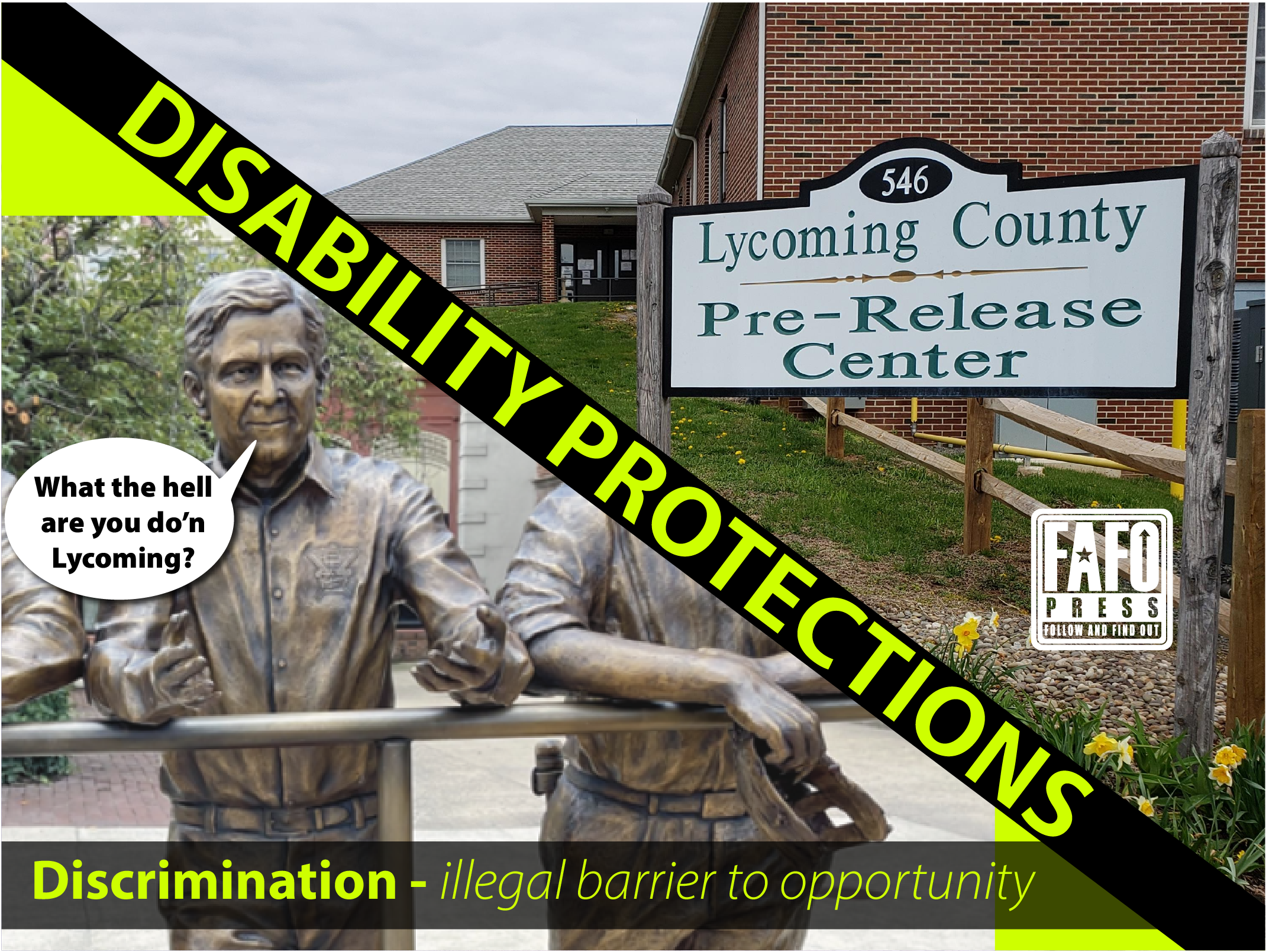
PRC’s Policy Gaps: Ignoring Disability Protections in Work Release
July 15, 2025
FAFO Press
WILLIAMSPORT, PA – In Pennsylvania, employers who provide jobs for work-release prisoners are subject to the same employment laws as other employers, which includes complying with the Americans with Disabilities Act (ADA). The ADA requires employers to provide reasonable accommodation for qualified employees with disabilities, unless doing so would cause undue hardship.
Furthermore, the Pennsylvania Human Relations Act (PHRA) also addresses discrimination based on disability. Employers must make reasonable accommodations for employees with disabilities, like the requirements of the ADA.
President George W. Bush’s Executive Order issued on June 18, 2001, requires federal agencies to enforce the ADA by promoting community-based living for individuals with disabilities in institutionalized settings. It emphasizes collaboration with states, removing barriers, and ensuring proper placement in integrated settings to support independence and participation.
While prison work-release programs may have specific guidelines or agreements that influence employment practices, such as disciplinary write-ups, they do not have any legal privileges or exceptions that allow them to operate in a way that conflicts with anti-discrimination laws. Facilities like Lycoming’s PRC are bound by statutes and legal mandates that prohibit discrimination, and no administrative agreement or policy exempts them from these requirements.
Detailed in the “Lycoming County Pre-Release Center Male Unit Guidebook, the Performance Evaluation Period (PEP) – a mandated 45-day phase before inmates can qualify for work release, acts as a significant barrier to successful reentry into society. While designed ostensibly to assess a resident’s reliability, attitude, and ability to follow rules, the PEP often extends the cycle of incarceration rather than promotes rehabilitation. Even missing time from prison prescribed work, while looking for a job on CareerLink resets an inmate’s PEP. The social contract with the inmate populations per the guidebook details PEP as follows:

On December 12, 2022, a Lycoming County Pre-Release Center (PRC) counselor disclosed that the facility had contracts with three local businesses to offer work-release opportunities. These were Wire Rope Works Inc., Williamsport Steel Container, and Danzer Veneer. The same counselor also explained that an inmate with physical disabilities was denied access to work release because none of the contracted employers associated with the PRC were able to accommodate his disability, highlighting a significant barrier to equitable employment opportunities for disabled individuals seeking successful reentry. The inmate met all the requirements of the facility’s PEP standards.
The Americans with Disabilities Act (ADA), enacted in 1990, states employment contracts and agreements must be free of discriminatory practices. It is a clear mandate: no one should knowingly enter or support employment practices that discriminate based on disability.
FAFO Press made an inquiry with the county and has verified that the Lycoming County Prison receives federal funding as pass-through grants through the Pennsylvania Commission on Crime and Delinquency (PCCD). Most prisons have some sort of federal funding. The Lycoming County Budget for 2025 allocated $2,966,531 to operate PRC with expected revenues totaling $38,975.
Complementing the ADA is Section 504 of the Rehabilitation Act of 1973, which extends protections to programs and activities receiving federal financial assistance. This law ensures that organizations working with or funded by the federal government uphold nondiscrimination policies, further reinforcing commitment to inclusivity for people with disabilities. In short, the PRC’s willful neglect with deliberate indifference could put the facility into a position where losing federal funds could be a real possibility.
The County of Lycoming makes it clear in its own policy #105 that discrimination will not be tolerated. The county policy is consistent with the law. So where is the disconnect at a county agency like the prison?
PRC packs large passenger vans every weekday to the county landfill with inmates. The inmates sort trash and other tasks for 60 cents an hour. The county pays a starting wage of $20 an hour for someone off the street to do the same job. Lycoming County saves a very large amount of money every day they pack those vans full of inmates.

Two local policies to the PRC, 13.0 and 18.7, govern access to work-release opportunities and programs who are returning to society. These policies also contain the language for the required anti-discrimination policy. The anti-discrimination policy language is a requirement per Title 37 PA Code § 95.235 (5) which governs county prisons, states:
“Written local policy must specify that there may be no discrimination regarding access to a work program based on an inmate’s race, religion, national origin, gender or disability.“
At a recent prison board meeting, Commissioner and board Chairman Scott Metzger reassured a citizen a solicitor is looking into the language of PRC work release anti-discrimination policies. That citizen discovered that in both policies, the word “disabilities” is absent as a protected class. He has been advocating Since 2023 to eliminate this structural barrier in policy.


Lycoming County’s policies reveal a disturbing neglect of fundamental rights. Despite laws like the ADA, the PRC’s own rules either omit or ignore protections for disabled inmates, outright denying them access to work release. This blatant discrimination, fueled by federal funding and a focus on cost-cutting, perpetuates injustice rather than fostering true rehabilitation. Until these policies are urgently revised to ensure fair and equal treatment, reach out to the Lycoming County Commissioners, and voice your opinion and as always attend those board meetings.
Contact the Lycoming County Commissioners: [email protected]
FAFO Press will continue to monitor progress toward ensuring that those who suffer from disabilities do not also suffer from publicly funded systemic discrimination by the hands of officials who struggle to interpret the will of the people and act accordingly.
